 Stuart Kerr Spindlow
Start with the constraint that changes the choice
I recommend shortlisting project software around the work that needs improving: ClickUp for task-based backlog planning, monday work management for structured requests, GitHub Projects for repository-linked delivery and Trello for a compact shared board. Keep your current process in the comparison. A new subscription should solve a specific problem, not just add another place to track it.
I have used ClickUp, monday work management, GitHub Projects and Trello. The shortlist is organised by workflow fit; it is not a scored benchmark. Linked product details were checked on 9 September 2026.
First decide whether the problem is request intake, backlog organisation, repository-linked delivery or simply unclear ownership. A single owner and a consistent review routine may solve the last problem without a new subscription. Do not select a tool before agreeing the work it must improve.

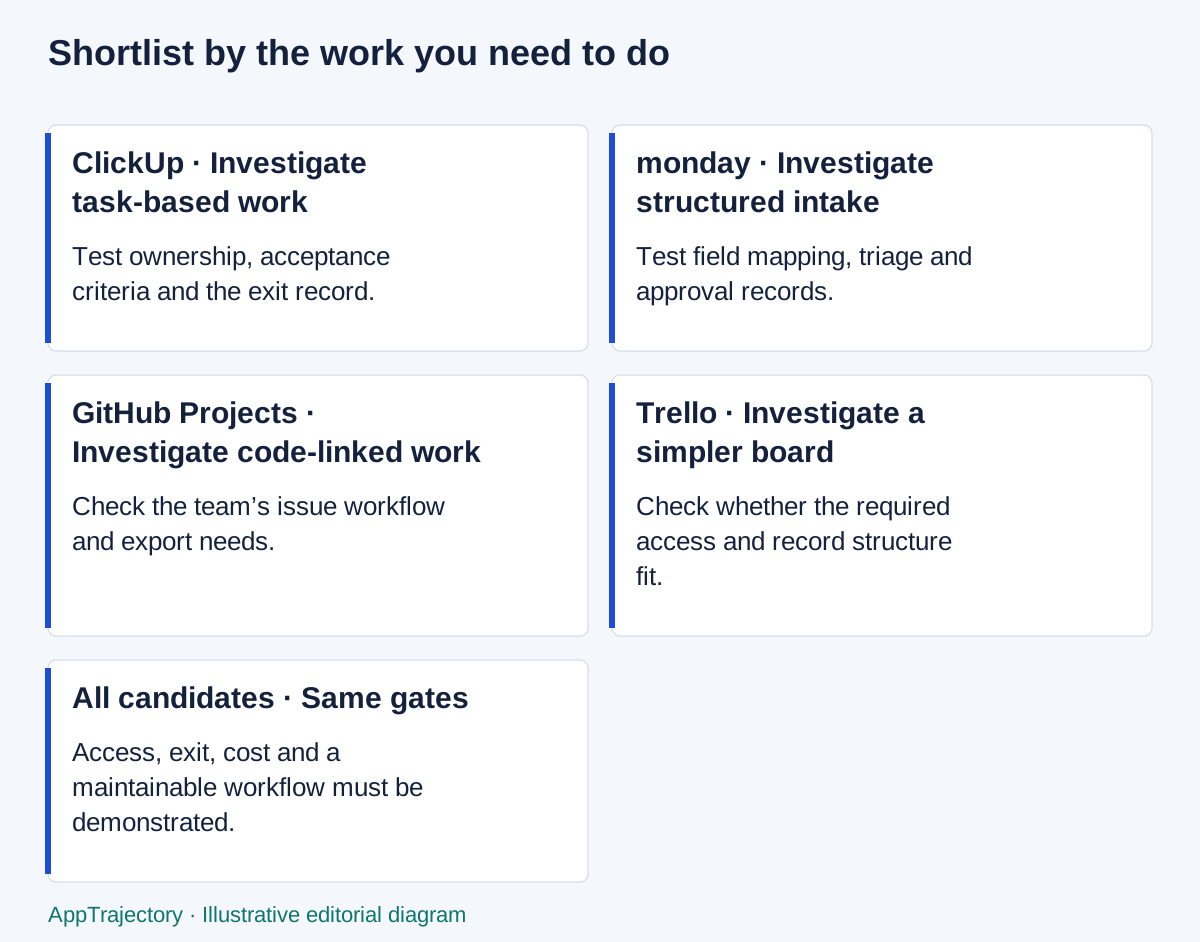
Read the diagram as text
- ClickUp · Investigate task-based work: Test ownership, acceptance criteria and the exit record.
- monday · Investigate structured intake: Test field mapping, triage and approval records.
- GitHub Projects · Investigate code-linked work: Check the team’s issue workflow and export needs.
- Trello · Investigate a simpler board: Check whether the required access and record structure fit.
- All candidates · Same gates: Access, exit, cost and a maintainable workflow must be demonstrated.
Selection decision: fit, limits and checks
| Decision question | Practical answer |
|---|---|
| Best fit | Shortlist by the primary workflow: backlog organisation, structured request intake, repository-linked delivery or a compact shared board. |
| Poor fit | Buying a new workspace to compensate for an unassigned owner or an undefined approval routine. |
| Essential versus optional | Gate on roles, required records, usable exit and complete budget; treat dashboards and extra views as preferences unless the workflow needs them. |
| Before purchase | Run one complete request with an exception, intended guest role and export. Check the plan you will buy rather than only the trial. |
| Alternative condition | Retain the current system if it passes the essentials and migration has no defensible benefit; reconsider a specialist option when the required workflow narrows. |
These are editorial selection judgments based on this guide’s stated evidence and assumptions. They are not new hands-on results. Use the selection methodology and scorecard to preserve your own acceptance checks and evidence.
Four candidates and the current process
ClickUp is a candidate for task-based project planning and backlog organisation. Validate whether the team understands locations, priorities and status, and whether the chosen plan meets the access and exit requirements.
monday work management is a candidate for structured request intake and board-based coordination. Check the form mapping, approval responsibility, duplicate handling and the real billable seat bundle. Keep CRM and dev outside this shortlist.
GitHub Projects documents table, board and roadmap views linked to issues and pull requests. Investigate it when delivery already lives in GitHub; test whether non-developer reviewers can complete their part without creating another tracking process.
Trello’s pricing page lists a Free plan for up to ten collaborators per Workspace and ten boards. It is a candidate for a compact shared task board. Check whether the required approval record, permissions and export route fit the actual plan before treating free access as a complete solution.
The current shared register is a fifth option. Record its owner, review cadence, access boundary and method of retaining decisions. Apply the same task exercise instead of treating the baseline as automatically inferior.
Use comparable evidence
Run the same synthetic request through each plausible candidate: intake, ownership, priority, acceptance criteria, a prohibited access attempt, approval, status communication and export. Eliminate a candidate only for an essential requirement or a documented tradeoff the team accepts.
Illustrative decision note: “External reviewers must only see their client’s records; export must preserve the approver and accepted version.” This is stronger than “easy to use”, because the pilot can establish whether it is met. It is a proposed criterion, not a result.
Price the working arrangement
Record the required plan, internal members, guests, minimum billable seats, currency and billing cycle. Add training, administration, migration, overlap and exit work. Check paid automation or AI requirements separately. An advertised per-seat rate does not establish the whole cost.
Use the requirements worksheet before the evaluation scorecard. Set criteria before scoring and retain evidence beside each score. Do not use commission as a criterion.
Turn the shortlist into a choice
Use the ClickUp and monday comparison if those two approaches fit your requirements. Include GitHub Projects or Trello when their documented model better matches where the team already works. Give each serious candidate the same relevant tasks and cost assumptions; do not score an untested permission boundary as passed.
Pick one or two candidates that fit the actual workflow, name the person who will maintain the setup and agree a decision date. I would keep the current system available until essential access and exit checks pass. If no candidate clears those gates, improve the process or resolve the remaining requirement before buying.
Compare the candidates
| Candidate | Reason to investigate | Main check |
|---|---|---|
 ClickUp ClickUpFull evaluation | Task-based backlog planning | Can the team maintain the hierarchy and obtain the required permissions/export route? |
 monday work management monday work managementFull evaluation | Structured project-request intake | Do mapping, ownership and approval survive invalid and duplicated submissions? |
 GitHub Projects GitHub Projects | Work already tracked in issues and pull requests | Can non-developer participants perform their work with the intended access? |
 Trello Trello | A compact shared board | Does the chosen plan support the required controls and exit record? |
| Current process | Ownership and review already work | Is the actual cost or failure rate sufficient to justify switching? |
ClickUp
- Reason to investigate: Task-based backlog planning
- Main check: Can the team maintain the hierarchy and obtain the required permissions/export route?
monday work management
- Reason to investigate: Structured project-request intake
- Main check: Do mapping, ownership and approval survive invalid and duplicated submissions?
GitHub Projects
- Reason to investigate: Work already tracked in issues and pull requests
- Main check: Can non-developer participants perform their work with the intended access?
Trello
- Reason to investigate: A compact shared board
- Main check: Does the chosen plan support the required controls and exit record?
Which one I would choose
For a six-person team that only needs a shared internal board, my first choice is Trello Free, provided the workspace remains within its collaborator and board limits and the required controls are available. For a growing backlog of delivery tasks, I would choose ClickUp. For a coordinator managing structured request intake, I would choose monday work management. For software work already tracked in GitHub issues and pull requests, I would choose GitHub Projects. Those are different winning use cases, not an overall ranking shaped by referral links.
| Option | Subscription arithmetic | Why the number is not the whole decision |
|---|---|---|
| Trello Free | $0 within the published free allowance | Up to ten collaborators and ten boards; do not assume paid export or observer controls. |
| Trello Standard, annual billing | 6 × $5 × 12 = $360 USD | Consider for its additional board and field features; it is not equivalent to every Premium control. |
| Trello Premium, annual billing | 6 × $10 × 12 = $720 USD | Consider when its views, observers or simple data export are required. |
| ClickUp Full evaluation | Unlimited $504; Business $864 USD annually | Select by required controls and recurring export needs, not just the lower total. |
| monday work management Full evaluation | Ten-seat subscription for six internal members | The matched-plan price is not established here; compare the actual total per active person. |
| GitHub Projects or the current register | Use the existing account and required access costs | A tool already paid for can still require administration or a different permission arrangement. |
Price inputs: Trello and ClickUp checked 23 September 2026. All priced rows use six paid members, twelve months and annual billing, excluding tax, guests, extras and labour. The plans are listed for different requirements, not presented as feature-equivalent. ClickUp versus monday examines the closer buying choice.
My main caution is to avoid moving repository delivery into another system merely to get a second board, or moving a simple board into a configurable suite without a requirement for the extra structure. The better choice reduces the work the team must keep consistent.
Explore the options
Sources and scope
The sources below support the feature, price and plan details in this guide. Prices and limits may change; check the actual order and plan.
- ClickUp pricing
- ClickUp backlog and sprint guidance
- ClickUp epics and user stories
- ClickUp guest roles
- ClickUp export guidance
- Build a monday WorkForm
- monday shareable boards and guests
- monday Excel export limitations
- monday plan and seat-bundle pricing
- monday product pricing
- About GitHub Projects
- Trello plans and limits