 Stuart Kerr Spindlow
Choose against the same job
I would begin with ClickUp for task-based backlog work and monday work management for structured project intake, then compare both against the same delivery job. Neither starting point is a universal winner. Choose the product that meets your access, approval and export requirements with an operating burden the team can manage.
I have used ClickUp and monday work management hands-on. The shared scenario is illustrative, not a measured head-to-head result. Linked product details were checked on 9 September 2026.
Use Onboarding Refresh with six internal members, a named delivery lead, a reviewer and the same five synthetic records. Count any chargeable external roles separately. The comparison is project delivery, not monday CRM, and it should not penalise a product for a capability outside the agreed task.

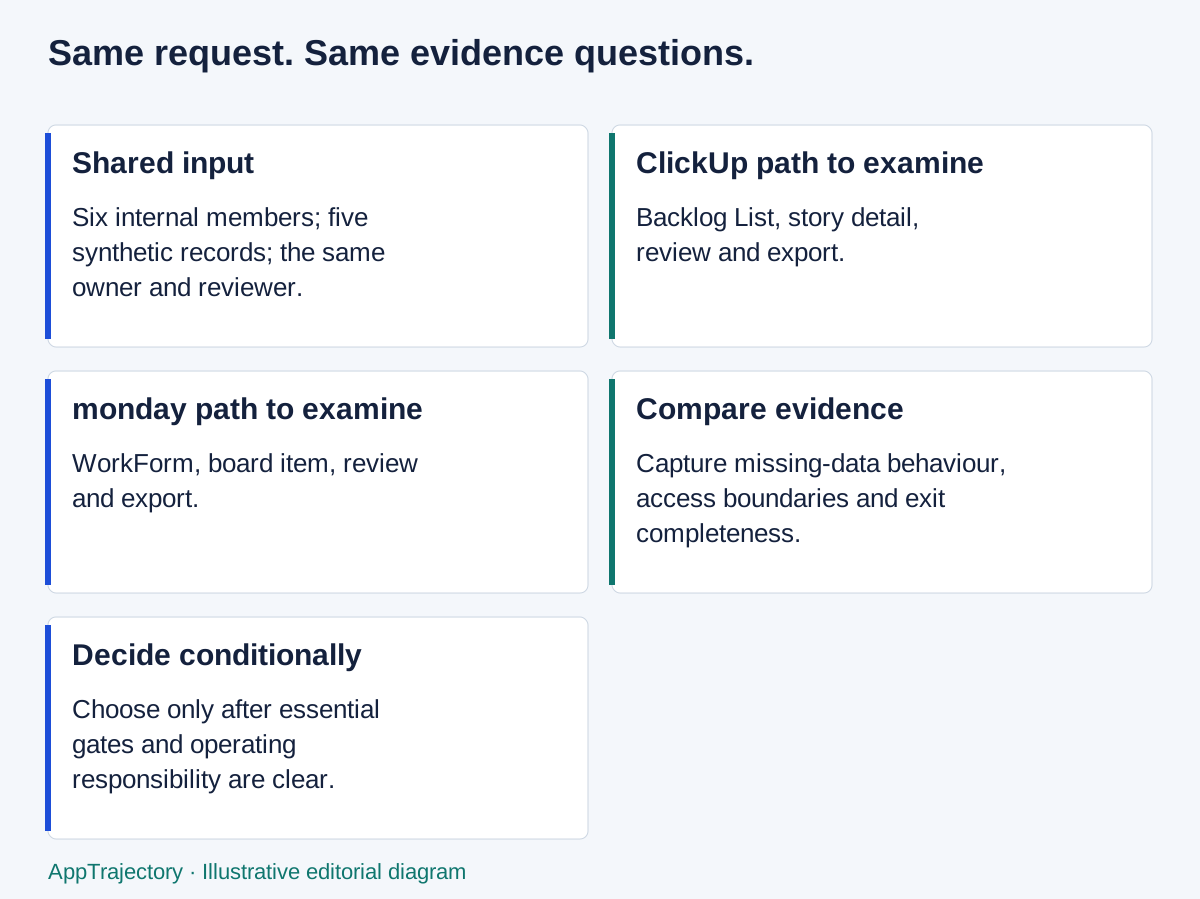
Read the diagram as text
- Shared input: Six internal members; five synthetic records; the same owner and reviewer.
- ClickUp path to examine: Backlog List, story detail, review and export.
- monday path to examine: WorkForm, board item, review and export.
- Compare evidence: Capture missing-data behaviour, access boundaries and exit completeness.
- Decide conditionally: Choose only after essential gates and operating responsibility are clear.
Selection decision: fit, limits and checks
| Decision question | Practical answer |
|---|---|
| Best fit | Choose by the same end-to-end job: ClickUp for backlog-first planning; monday work management for intake-led coordination. |
| Poor fit | Naming an overall winner from feature counts while the access, approval or export requirement is unresolved. |
| Essential versus optional | Gate on the required roles, retained decision record and budget for the actual team; weight workflow convenience only after those pass. |
| Before purchase | Use the same synthetic request, approval change, prohibited guest action and export reconciliation on both intended plans. |
| Alternative condition | Keep the baseline or use a simpler/repository-linked tool if neither candidate produces enough useful improvement to justify switching. |
These are editorial selection judgments based on this guide’s stated evidence and assumptions. They are not new hands-on results. Use the selection methodology and scorecard to preserve your own acceptance checks and evidence.
Compare the whole path
For intake, submit a complete request, an incomplete request and a duplicate. For delivery, assign ownership, prioritise the work and attach acceptance criteria. For governance, test a prohibited action and approve a specific version. For communication, ask the intended participant to identify the current decision. Finally, export a record another person can interpret.
ClickUp's task and backlog model makes it worth shortlisting for story-led delivery; monday's form and board model makes it worth shortlisting for coordinated request intake. Both still need to pass the complete workflow. A strong intake experience does not compensate for a missing approval record, and a detailed backlog does not fix unclear ownership.
Make plan differences visible

Choose the lowest plan in each product that actually passes the essential requirements. Do not present two entry-level prices as comparable when one excludes the needed permissions or export route. Record WorkForms dependencies, guest mix and recurring credits or add-ons separately.
Illustrative cost method: calculate billable seats times the monthly-equivalent rate times twelve, then add the same categories of internal effort, migration and exit work. Use the existing cost calculator with stated exclusions. A numerical difference between incomplete estimates is not a proven saving.
Interpret limitations rather than count features
One failed essential access boundary can outweigh several convenience features. A manual duplicate review might be acceptable at five requests a week and burdensome at fifty. State the actual input volume and expected operational owner before judging the workaround.
Distinguish an unsupported capability, a configuration mistake and a task the tester could not complete. Record vendor documentation beside the observation. Give both products the same chance to resolve an identified setup error, while recording the help needed.
When keeping the current process wins
If a shared register already preserves ownership, decisions and access at an acceptable cost, switching needs a specific benefit. Include the cost of maintaining the current process and the disruption of migration. The baseline should receive the same task assessment as the vendors.
My choice would turn on where the team needs the most structure and what it can maintain. Read the ClickUp assessment and monday work management assessment for their specific constraints. If both pass the essentials, choose the workable arrangement with the clearer ownership and justified total cost; if neither improves on the baseline, keep the current process.
Compare the candidates
| Decision |  ClickUp ClickUpFull evaluation |  monday work management monday work managementFull evaluation |
|---|---|---|
| Starting model | Tasks and backlog Lists; decide when to add or move work into sprints | Questions mapped to board fields, followed by team-owned triage |
| External review | Check plan-specific guest permissions and the shared location | Check shareable-board availability, guest charges and role boundaries |
| Exit record | Identify the task-data, view and document export routes separately | Check the board export and the exclusion of subitem updates |
| Operating work | Name the person maintaining task structure and statuses | Name the person maintaining form mappings and duplicate review |
ClickUp
- Starting model: Tasks and backlog Lists; decide when to add or move work into sprints
- External review: Check plan-specific guest permissions and the shared location
- Exit record: Identify the task-data, view and document export routes separately
- Operating work: Name the person maintaining task structure and statuses
monday work management
- Starting model: Questions mapped to board fields, followed by team-owned triage
- External review: Check shareable-board availability, guest charges and role boundaries
- Exit record: Check the board export and the exclusion of subitem updates
- Operating work: Name the person maintaining form mappings and duplicate review
My winners for specific small-team needs
| Main constraint | My choice | Reason and tradeoff |
|---|---|---|
| Accepted requests need a maintained delivery backlog | ClickUp | The task/List model fits story refinement; someone must keep the hierarchy and statuses understandable. |
| Incoming requests arrive inconsistently | monday work management | The form-to-board model gives triage a defined entry point; mapping, duplicates and approvals still need an owner. |
| Work already lives in repository issues and pull requests | GitHub Projects | Avoid a separate delivery record when its repository-linked views meet the requirement; include non-developer access in the decision. |
| One coordinator already maintains a reliable register | Keep the current process | A second system adds migration and maintenance without a demonstrated benefit. |
These are recommendations from the documented models and this guide’s shared task, not winners from measured head-to-head testing. Both ClickUp and monday can serve broader workflows; the table identifies where I would start, rather than claiming that either lacks the other’s category of feature.
For six internal members and annual billing, ClickUp Unlimited calculates to $504 USD and Business to $864, using prices checked on 23 September 2026. monday’s seat policy requires ten seats for that headcount. A ten-seat quote exceeds those totals above $4.20 or $7.20 per seat per month respectively, before tax and extras. Those are calculated comparison thresholds, not quoted monday prices. The selected monday plan price remains unverified here, so a cash-price winner would be premature.
For client collaboration, compare role permissions rather than the word “guest”. For recurring view exports, include the appropriate allowance or higher plan. The ClickUp assessment explains the current export-documentation discrepancy; the monday assessment explains its approval-record and seat-bundle limitations. I would choose the workflow winner only after an essential access or retention requirement has a supported route.
Explore the options
Sources and scope
The sources below support the feature, price and plan details in this guide. Prices and limits may change; check the actual order and plan.