 Stuart Kerr Spindlow
Evaluate project requests, not a whole product family
I would shortlist monday work management when a small team needs a consistent route from project requests to ownership and delivery. Its form-and-board approach is worth considering when coordinators need a shared intake process. Check the seat bundle, access boundaries and approval record before buying. This assessment covers work management, not monday CRM or monday dev.
I have used monday work management hands-on. The worked examples are illustrative, and the linked product details were checked on 9 September 2026. Confirm the plan and requirements for your own team.
A useful evaluation follows one request all the way from submission to approval and export. If the process breaks after intake, a polished form has not solved the team’s problem. Compare the same synthetic request with the existing process and ClickUp before choosing.

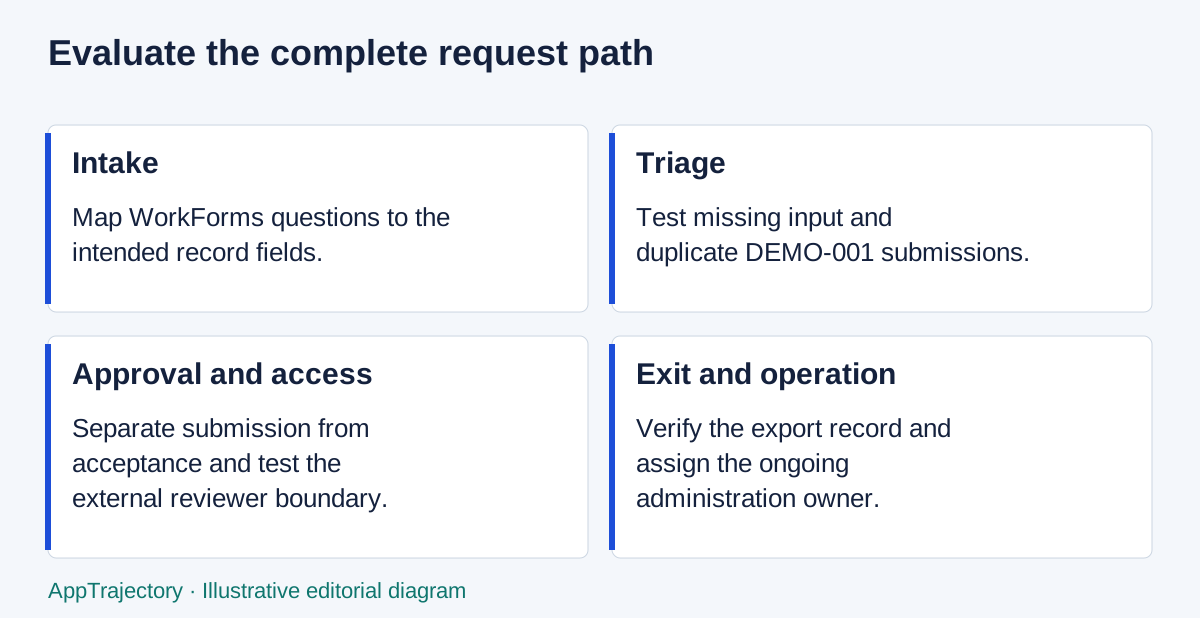
Read the diagram as text
- Intake: Map WorkForms questions to the intended record fields.
- Triage: Test missing input and duplicate DEMO-001 submissions.
- Approval and access: Separate submission from acceptance and test the external reviewer boundary.
- Exit and operation: Verify the export record and assign the ongoing administration owner.
Selection decision: fit, limits and checks
| Decision question | Practical answer |
|---|---|
| Best fit | A team selecting around structured request intake, board-based triage and a named decision owner. |
| Poor fit | Treating a form submission as approval or relying on a filtered board as proof of client confidentiality. |
| Essential versus optional | Gate on complete request mapping, role boundaries, recoverable decisions and a quote for the actual seat/guest mix; attractive views are secondary. |
| Before purchase | Submit valid, incomplete and duplicate requests; inspect mapping, permission boundaries and which approval details survive export. |
| Alternative condition | Consider ClickUp for backlog-first delivery, GitHub Projects for repository-linked work or keep the current intake if it already supports a reliable decision record. |
These are editorial selection judgments based on this guide’s stated evidence and assumptions. They are not new hands-on results. Use the selection methodology and scorecard to preserve your own acceptance checks and evidence.
Intake is only the first step
Start with the requested outcome and the fields a coordinator needs for triage, then map the form to the board. I would keep assignment and approval under team control. A completed submission should enter the review process, not silently become a delivery commitment.
Observe a valid request, an omitted required answer and a repeated reference. Then ask another participant to identify the owner and latest decision without coaching. Record uncertainty and manual reconciliation work instead of assuming every transition is automated.
Check roles and plan costs together
Shareable boards are documented on Standard and higher plans. Guest use and charges depend on the plan. That establishes a plan question, not a passed confidentiality test. Try prohibited access using synthetic records before selecting a subscription.
Keep the same internal headcount when comparing quotes. The existing billing evidence describes a three-seat minimum followed by bundles in multiples of five; six internal users therefore require a ten-seat bundle in that model. Confirm the actual quote, currency, billing cycle, guest mix, WorkForms entitlements and any credit/add-on requirements. Do not borrow prices from CRM or dev.
Preserve the approval record outside the board
The Excel export guidance says subitem updates are excluded. If the important approval conversation lives there, define another supported retention route and test it. A visible item or exported status alone may not explain who accepted which version.
Illustrative acceptance check: another reviewer can reconstruct DEMO-001 from the export without opening monday. They should identify the requested outcome, owner, accepted version and reason for later correction. Record what is missing and whether the workaround is acceptable for the team’s actual retention needs.
Decision and alternatives
Investigate ClickUp when the main uncertainty is backlog organisation, GitHub Projects when work already centres on repository issues, and a shared intake register when manual triage is reliable. Apply the same task evidence and cost horizon to each. No product wins merely by appearing in a commercial shortlist.
I recommend monday work management when the form-to-board process helps the team manage requests and preserve decisions at an acceptable total cost. Use the project request workflow and pilot plan to check that fit. Keep a simpler intake register when its manual triage remains reliable and easier to maintain.
My verdict on fit and the seat bundle
I would choose monday work management when incoming requests need a consistent form and a visible triage board. I prefer ClickUp when the harder problem is organising accepted work into a backlog, and GitHub Projects when the delivery record already lives with code. A shared register remains the winner when requests are infrequent and one coordinator can maintain the approval trail reliably. This is an editorial recommendation about workflow fit, not a claim that monday was faster in a timed test.
The seat rules checked on 23 September 2026 make a six-person team buy ten member seats. Four seats are unused in that example: 40% of the purchased capacity. Divide the total subscription by six to compare the cost per active person with another product. At ten active members, that particular unused-capacity penalty disappears; this is why headcount can change the value assessment without any feature changing.
The available evidence does not establish a currently selected, matched-plan USD price for this comparison, so I do not declare monday more expensive overall. Its form, reviewer role, export route and any required WorkForms features must be priced together. My recommendation is to pay for the coordinated intake when that is the problem being solved, rather than pay for an attractive board while approvals still disappear into messages.
Explore the options
Sources and scope
The sources below support the feature, price and plan details in this guide. Prices and limits may change; check the actual order and plan.