 Stuart Kerr Spindlow
My recommendation
I would start with Make for a modest project-intake workflow when a coordinator can maintain its visual routing and the required app actions fit. I would shortlist n8n Cloud when a technically confident owner needs more custom data handling or expects the workflow to develop beyond a straightforward handoff. If your team already runs either successfully, keep it unless a specific requirement justifies switching.
I have used Make and n8n. This comparison applies them to the same job: turn an approved Google Sheets request into a ClickUp task and return its receipt. The recommendations combine that product familiarity with documented capabilities and an illustrative workload. They are not a claim that I timed equivalent runs or measured a reliability winner.
For this decision, compare Make with n8n Cloud first. Self-hosting n8n adds a separate responsibility for the platform; it is not simply a cheaper version of the same operating arrangement.

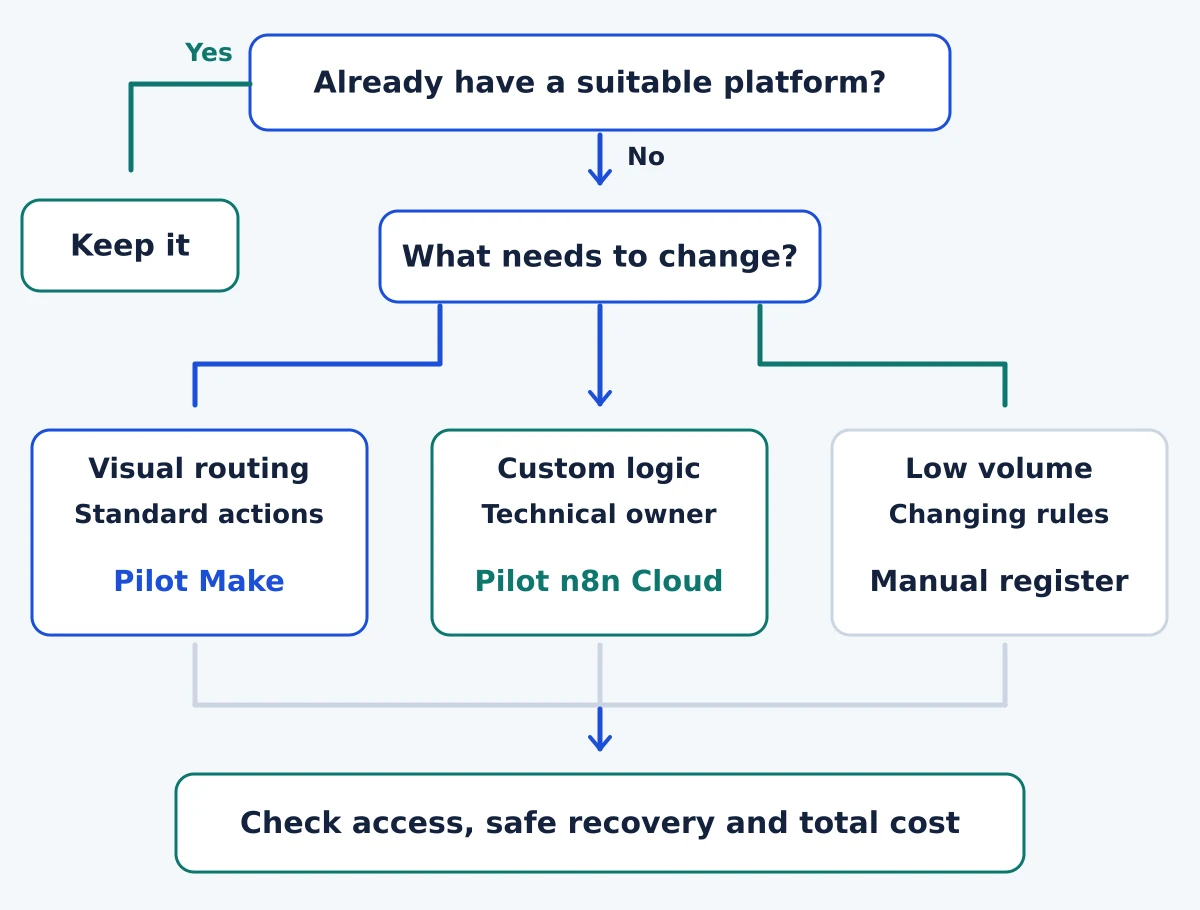
Read the diagram as text
- Existing platform: Keep it if it passes the requirements.
- Make: Pilot standard actions with maintainable visual routing.
- n8n Cloud: Pilot custom logic with a technically confident owner.
- Manual: Keep a register when volume is low and approval rules change.
Selection decision: fit, limits and checks
| Decision question | Practical answer |
|---|---|
| Best fit | Compare Make and n8n for the same approved-request workflow, with a named owner for mappings, state and recovery. |
| Poor fit | Choosing on credits versus executions alone, or self-hosting without an operator and a tested restore route. |
| Essential versus optional | Gate on approved-version handling, stable identity, receipts and recovery; hosting control is essential only when an actual constraint requires it. |
| Before purchase | Exercise a failed receipt and overlapping requests, reconcile the ledger and model workload plus operator time. Use the controls and limits of the actual configuration. |
| Alternative condition | Keep an existing supported platform when it passes; use manual intake if the process is unstable or the cost of maintaining automation exceeds the benefit. |
These are editorial selection judgments based on this guide’s stated evidence and assumptions. They are not new hands-on results. Use the selection methodology and scorecard to preserve your own acceptance checks and evidence.
Which should you shortlist?
| Situation | My starting choice | Decisive check |
|---|---|---|
| A small handoff with visible routing and standard app actions | Make | The future operator can explain the filters and recover a missing receipt. |
| Custom transformations and a technical workflow owner | n8n Cloud | The required nodes and permitted code behaviour fit the managed environment. |
| An established platform already passes the requirements | Keep it | Any proposed gain exceeds migration and maintenance costs. |
| A platform requirement demands self-hosting | Assess self-hosted n8n separately | A named team owns updates, restore tests and incident response. |
| Low volume and changing approval rules | Keep a manual register | Receipts remain reliable without another system. |
Make
- Situation: A small handoff with visible routing and standard app actions
- Decisive check: The future operator can explain the filters and recover a missing receipt.
n8n Cloud

- Situation: Custom transformations and a technical workflow owner
- Decisive check: The required nodes and permitted code behaviour fit the managed environment.
These are conditional recommendations. A missing essential action, access control or recoverable failure path outweighs my starting preference.
Compare the same approved request
Use a fictional request with a permanent reference, an approved version, a title, a delivery owner and the intended outcome. Keep the same spreadsheet, destination List and acceptance rules in both candidates. The handoff must reject unapproved changes, mark work as Processing before creation, return the task ID and URL, and hold ambiguous outcomes for investigation.
Our Make intake walkthrough revisits eligible spreadsheet rows on a schedule. Our n8n intake walkthrough uses a row-change trigger and a processing ledger. They implement the same business contract with different mechanics; their number of steps and billing events need not match.
A new-row-only trigger can miss a request approved later. Make documents Search Rows and row-update modules; n8n documents row-added and row-updated events. Check the actual editing pattern. A receipt written back by the automation must not become another eligible creation request.
Choose the workflow your team can maintain
For the Make version, I would keep routing and mapping visible and minimise exceptions that only the original builder understands. A coordinator should be able to follow the request from eligibility through creation to its receipt. The useful question is whether a backup can explain each branch, not whether the canvas looks tidy.
n8n's Code node supports custom JavaScript or Python logic. That is useful when a maintained transformation is clearer than many mapping expressions. It also creates code that somebody must understand. Cloud has restrictions that differ from self-hosting, so do not assume an arbitrary package, filesystem operation or shell command is available.
I would choose n8n Cloud for custom logic only when there is an owner and a documented reason for it. Neither platform requires custom code for every workflow, and Make should not be dismissed merely because the alternative exposes a code node. Start by checking the exact fields and actions you need.
A receipt failure should decide the pilot
The revealing case is a task created in ClickUp whose response or spreadsheet receipt is lost. Repeating the entire creation path may make a second task. Keep the permanent request reference in the task, inspect the destination before retrying, and distinguish confirmed failure from an unknown outcome.
Make's scenario settings support ordered processing and stored incomplete executions. Ordered processing can pause later runs until incomplete work is resolved. That reduces one kind of overlap but makes prompt exception handling important. It does not prevent a person or a second scenario from writing independently.
n8n supports error workflows and Data Tables for persistent workflow data. A ledger helps record what happened; checking and then updating a row is not, by itself, an exclusive lock. Neither design commits the spreadsheet, ledger and ClickUp task as one transaction.
My selection rule is simple: the backup operator must recover a deliberately interrupted handoff without blindly recreating the task. If neither candidate passes, improve the design before buying more capacity.
Credits and executions need different ledgers
Make's credit documentation assigns one credit to standard non-AI operations. Its operations guidance explains how checks and downstream bundles affect usage. n8n Cloud prices its plans around workflow executions, rather than charging once for every internal node. Comparing 1,000 credits with 1,000 executions therefore does not compare equivalent capacity.
The following is arithmetic for an illustrative 100-request month, not observed account usage. The Make model assumes 176 scheduled searches and three standard actions per request. The n8n model assumes one admitted execution per request. Both exclude additional validation calls, writeback-triggered runs, retries, alerts and other workflows.
| Measure | Make | n8n Cloud |
|---|---|---|
| Narrow usage | 176 + (100 × 3) = 476 credits | 100 assumed executions |
| Published entry allowance | Free: 1,000 credits per month | Starter: 2,500 executions per month |
| Share used by this restricted model | 47.6% | 4% |
| Annual subscription starting point | Free: $0 within its limits | Starter: €20 × 12 = €240, billed annually |
Plan inputs were checked on 28 September 2026 at Make and n8n. The n8n amount excludes tax and other services. Free and Starter are different products with different limits, not equivalent feature packages. The percentages describe these chosen denominators; they do not prove one platform is more efficient.
For this small, standard-action pilot, Make has the stronger subscription-entry case if the complete workflow fits Free. An n8n subscription can still be justified by a better maintained workflow. Paid-plan comparisons need actual quotes in the same currency, billing period and required tier; this table does not establish a universal cash winner.
Schedule matters. A check every fifteen minutes throughout a thirty-day month produces 2,880 checks before delivery work. Conversely, a change-triggered workflow may start on edits that the first filter rejects. Measure both platforms' actual usage over representative activity. Do not turn 100 business requests into an assumed final bill.
Keep hosting and workflow ownership separate
n8n Cloud removes the need to run the n8n server yourself. Your team still owns credentials, approval logic, permissions, monitoring and business recovery. Self-hosting adds deployment, patching, backups, capacity and restoration duties. The n8n hosting documentation sets out that technical responsibility.
I would not self-host solely to avoid the Starter subscription. Compare the required edition, infrastructure and operating time in the Cloud versus self-hosted guide. Use the cost calculator with the same horizon and cost categories on both sides. An assumed hour of administration is an estimate until an operating record supports it.
Five checks before choosing
- Approval after entry: enter a draft, then approve its current version. Confirm it is found once eligible.
- Changed request: edit an accepted field without reapproval. Creation must stop until the new version is approved.
- Repeated input: present the same approved reference again. Inspect the task and receipt rather than trusting a green run indicator.
- Missing receipt: interrupt the return path in a controlled test. The operator must reconcile the existing task before retrying.
- Operator handover: have the backup explain the last confirmed step, recovery decision and usage record.
Record each outcome, required assistance and account configuration using the software pilot plan. Measure setup and recovery time consistently if speed will affect the purchase. No paired timing or success-rate evidence is supplied here, so I would leave those winners undecided.
My verdict
For a modest intake process, I would pilot Make first when standard modules and visible routing fit the owner. I would pilot n8n Cloud first when a technical team has a concrete custom-logic need and can maintain it. Keep an existing suitable platform ahead of either new purchase.
The deciding evidence is a correct approval boundary, a recoverable missing receipt and a cost model based on actual events. Choose the platform whose workflow your team can operate after its original builder is unavailable. Self-hosting remains a separate decision.
Check Make's current plans or n8n Cloud's current plans, then test the same handoff before committing.
Explore your next step
Review the current product options, then validate your required workflow before committing.
Is n8n Cloud right for your team?
For a plan-by-plan selection decision, read the n8n Cloud review for small project teams. It covers permissions, execution costs, operating limits and a practical purchase checklist.
Need a wider shortlist?
If these two platforms do not fit, compare workflow automation tools for small teams. The shortlist also explains when native ClickUp or monday automations avoid an unnecessary extra service.