 Stuart Kerr Spindlow
My verdict on n8n Cloud

I would shortlist n8n Cloud for a small team with a technically confident workflow owner, a real need for custom data handling and a backup who can recover failed handoffs. I would not choose it simply because the canvas can connect many apps. If nobody will own credentials, exceptions and changes, a simpler native automation or a manual approval register can be the better choice.
I have used n8n. This assessment combines that general product familiarity with current primary documentation and my editorial judgement about project-team fit. It does not claim a new timed Cloud benchmark, a measured reliability score or a completed permission test. Product sources were checked on 5 October 2026.

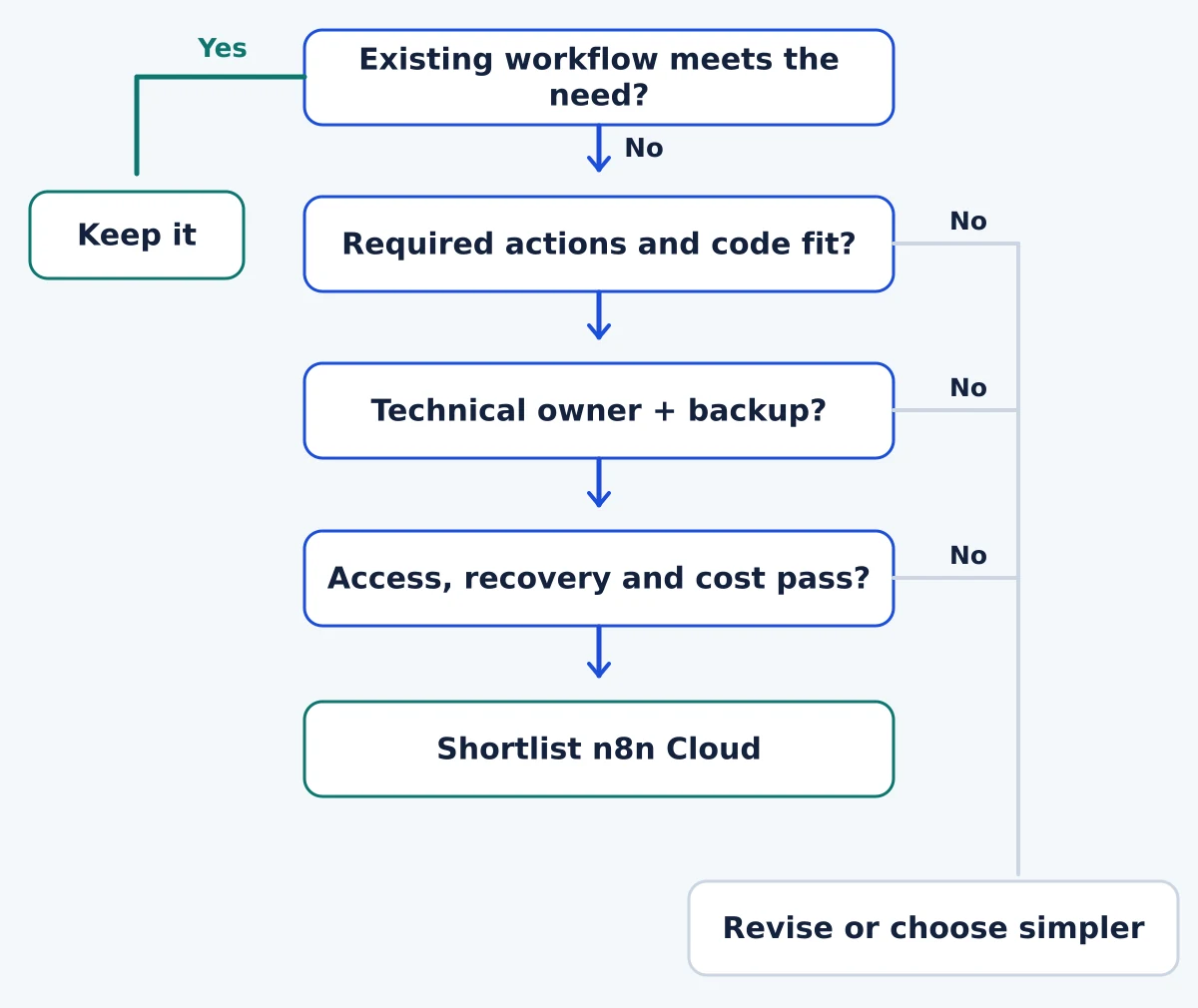
Read the diagram as text
- Existing fit: Keep an existing workflow when it satisfies the need.
- Cloud gates: Required actions and code, technical ownership, access, recovery and cost must fit.
- If a gate fails: Revise the design or choose a simpler option.
Who should put it on the shortlist?
| Criterion | My assessment | What would change the decision |
|---|---|---|
| Best fit | A technical owner building maintained cross-app project workflows. | The exact integration actions and permitted code must cover the task. |
| Poor fit | A team expecting a finished project-management system or unattended automation without an operator. | Choose an existing app’s native workflow when it completes the same job. |
| Essential versus optional | Required actions, access boundaries and a recoverable failure path are essential. AI features are optional unless the task needs them. | Do not let an attractive feature compensate for a failed essential requirement. |
| Before purchase | Check the actual paid tier, execution demand, retention needs and backup-operator access. | A successful trial is insufficient if it uses features absent from the intended paid plan. |
| Alternative condition | Consider Make for a visual handoff; compare self-hosting only when there is a specific operating requirement. | Keep the current platform if the improvement does not justify switching. |
My main advantage for n8n is the ability to combine visual workflow structure with explicit transformations. The trade-off is maintenance: an understandable transformation can improve a workflow, but opaque code creates dependency on its author. This is a qualitative buying assessment, not a numerical product score.
Assess the work, not the integration count
Start with one complete business outcome. For project intake, an approved request should become a task with the right owner and a receipt in the request register. The difficult questions are what happens after an edit, a missing field or a lost response, rather than whether a connector exists.
Use our n8n and ClickUp intake walkthrough as a design example. Before choosing Cloud, list the fields you need to read and write, the identity used by each connection, and the action that confirms completion. Test an approved request, an unapproved amendment and a duplicate reference. Keep those outcomes in the software pilot plan.
I would reject a pilot that only demonstrates the happy path. Ask a second person to recover a task created without its returned receipt. They should find the existing task using its permanent reference before deciding whether to retry. This is a proposed acceptance test, not a result I have measured for this review.
Cloud code has useful boundaries
The Code node documentation supports JavaScript and Python, but Cloud does not provide an unrestricted server environment. It restricts imported libraries; the documented JavaScript exceptions are crypto and moment, and Cloud Python does not permit library imports. Code nodes also have restrictions on filesystem access and HTTP requests.
For selection, identify every external library or system command in the proposed design before buying. If the required transformation can be written clearly with supported operations, Cloud remains a candidate. If it depends on an unavailable package, revise the design or assess a different operating arrangement. Do not assume that working code on a developer’s laptop will work unchanged in Cloud.
I would keep simple field mapping visual and reserve code for a transformation that becomes easier to explain, validate and maintain. Put representative inputs and expected outputs alongside that code, including empty values and malformed records.
Starter or Pro: what changes the buying decision?
The published annual-billing prices checked on 5 October 2026 are shown below. These are euro subscription inputs, before tax or external services, not a personalised quote.
| Plan | Monthly equivalent | Annual subscription | Monthly executions | Shared projects |
|---|---|---|---|---|
| Starter | €20 | €240 | 2,500 | 1 |
| Pro, entry tier | €50 | €600 | 10,000 | 3 |
Both include unlimited users and workflows. That does not mean identical permissions, capacity or operating features. My starting rule is to choose the lowest tier that passes every essential requirement, then confirm its current limits at checkout.
For a five-person team, the subscription equivalents are €4 or €10 per person per month, calculated by dividing €20 or €50 by five. n8n does not bill these plans by that headcount; these figures only help allocate a shared cost.
Operator time can outweigh the subscription difference. As a purely illustrative budget, two hours of monthly maintenance at €40 per hour would add €960 annually. Combined with Starter that is €1,200 per year; with entry Pro it is €1,560. Neither the hours nor the hourly rate is a measured n8n result. Replace both with your own evidence in the SaaS cost calculator.
Count runs and recovery work separately
An execution is a workflow run, rather than a fee for every internal step. Estimate normal events, scheduled runs and recovery activity separately, then compare the estimate with the account’s production usage. One business request can cause more than one workflow run if your design reacts to later edits or launches follow-up work.
For example, 100 accepted requests with one intended run each suggests 100 runs for that narrow path. It does not include rejected events, retries or other workflows. A count of records in the request register is therefore not an invoice forecast. Keep a usage log during the pilot and investigate differences before selecting an allowance.
Avoid comparing an execution allowance directly with another supplier’s credits. Our Make versus n8n comparison explains the different workload models. A lower displayed unit count does not prove a cheaper complete workflow.
Test the backup operator’s real access
n8n separates instance roles from project roles. Its permissions documentation describes projects as containers for workflows and credentials, with access that can differ between projects. Custom roles are an Enterprise capability. Choose your paid plan against the specific roles you need, not simply its user allowance.
The workflow-sharing documentation says editors can use credentials already used by a shared workflow, including credentials not separately shared with them. Editing nodes that use unshared credentials is restricted. Access to run a workflow and access to change its connection are therefore different questions.
- Name the account owner and backup before the pilot.
- Use a non-sensitive test connection to check who can view, run, edit and share the workflow.
- Confirm who can replace an expired credential and inspect a failed execution.
- Check that removing a team member leaves an authorised operator able to maintain the process.
For a client-separated agency workflow, project boundaries may become a stronger purchasing constraint than execution volume. Do not treat an unknown access result as a pass in the software evaluation scorecard.
Logs and memory are operating constraints
The Cloud data-management documentation warns that large or complex workloads can exhaust instance memory. It recommends reducing unnecessary data and processing smaller batches. Stored execution history is also subject to plan limits and pruning; it is not a permanent business audit trail.
I would keep the authoritative request reference and final receipt in the destination business systems. Decide how long you need diagnostic evidence, how quickly someone will investigate exceptions, and whether a missed alert could outlast the available history. Retention should support that response time.
Use representative payload sizes in the pilot, especially if your workflow handles attachments or large row sets. Passing a test with three tiny records does not establish capacity for a month-end import. This review provides no measured memory or throughput result, so those limits must be checked against your workload.
Use the trial to test fit and an exit
n8n documents a 14-day Cloud trial with Pro-level features and a 1,000-execution limit. Its pricing page lists specific trial exclusions, so do not assume complete paid-Pro equivalence. Compare the successful pilot with the tier you actually intend to buy. See the trial guidance and current plan terms.
The export documentation supports workflow JSON exports. It warns that exports can expose credential names or authentication headers included in node configuration. Inspect and sanitise an export before sharing it. A workflow file alone should not be treated as proof that every credential and external dependency can be restored.
- Document connections, owners, destination IDs and business rules.
- Export a safe sample and confirm what it contains.
- Test importing into an authorised evaluation environment before relying on an exit plan.
- Record what must be reconnected and which external data must remain available.
I would make this a purchase condition for a workflow that the team cannot afford to lose. Keep the detailed transition plan in the software migration checklist.
When I would choose something else
| Option | When I would consider it | What to check |
|---|---|---|
| Make | A coordinator can maintain a visual project handoff with standard modules. | Compare the same failure and recovery task; see Make vs n8n. |
| A native automation in your existing project app | The workflow stays inside one app and its existing rules satisfy the requirement. | Check access, logs and limits before adding another supplier. |
| Self-hosted n8n | A specific infrastructure or configuration requirement justifies operating the platform. | Use the Cloud vs self-hosted assessment and budget platform ownership. |
| A manual register | Volume is low or approval rules are still changing. | Name an owner, retain receipts and measure the actual administrative burden. |
A more capable platform is not automatically a better purchase. My preference is the smallest maintainable system that meets the requirement. If your current process already does that, the burden of proof sits with the proposed replacement.
My purchase checklist
Choose n8n Cloud when the required actions and Cloud code limits fit, the paid plan supports your access boundaries, and two people can explain and recover the workflow. Choose a simpler option when the workflow does not need that flexibility or operating ownership is weak.
- Every essential requirement has a verified pass or an explicit unresolved hold.
- Normal and exception paths have been demonstrated in the intended plan.
- The subscription and operating budget use your workload assumptions.
- Credentials, recovery, retention and export have named owners.
If your main alternative is Make, use the same-task comparison before committing. This assessment leaves speed and reliability winners undecided because equivalent measured tests are not available.