 Stuart Kerr Spindlow

This comparison is for a small team choosing where to coordinate project delivery. It does not compare Trello with GitHub as a source-code hosting service. A developer can keep using GitHub while the team uses Trello for wider coordination. The question is whether that split creates a useful boundary or a second record nobody maintains.
The decision in four requirements
| Requirement | Trello starting point | GitHub Projects starting point |
|---|---|---|
| Shared work record | A board-led queue understandable without repository context | Planning connected to issues and pull requests |
| Stakeholder participation | People need to follow the project as a shared board | Participants already work with the underlying GitHub records |
| Ownership of updates | A coordinator maintains the accepted board record | Delivery updates should stay connected to repository work |
| Exit requirement | Prove the chosen board/export route preserves required evidence | Reconcile a view export with linked implementation records |
Neither column is a universal winner or a numerical product score. Apply the same essentials first: the required people can access the right information, somebody owns each handoff, and the team can retrieve the record it needs. Optional views and personal familiarity help choose only after those gates pass.
Choose a source of truth before choosing the tool
For an illustrative six-person Onboarding Refresh project, imagine one request that becomes three implementation tasks. A request owner accepts the scope, a developer completes the change and a reviewer decides whether it meets the acceptance condition. These are different responsibilities, even when one person covers several roles.
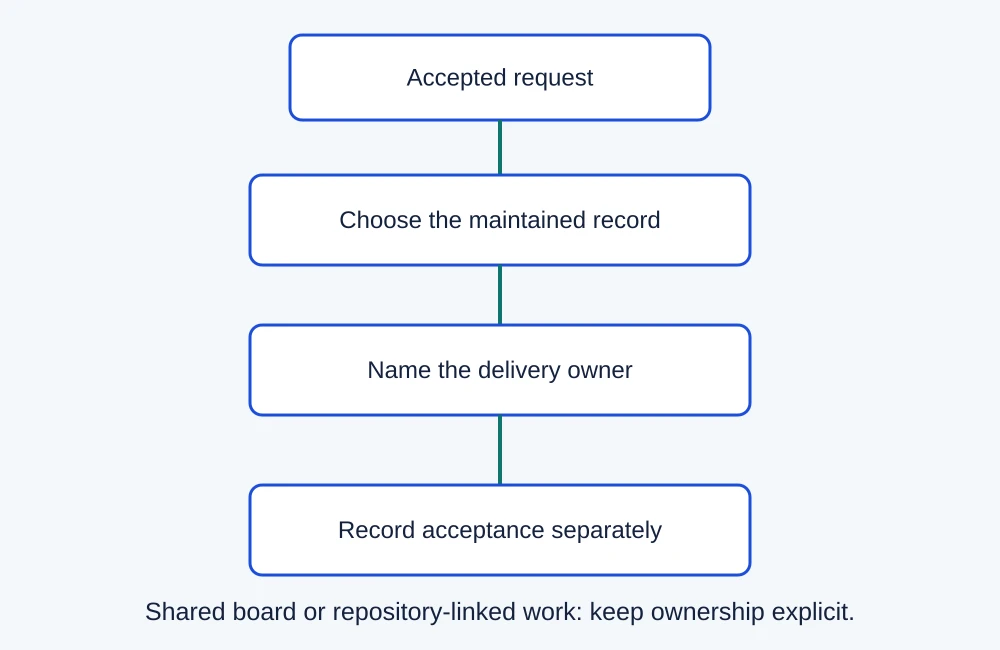
Trello is the more natural starting point when the board is the common language of the project. GitHub Projects is the more natural starting point when linked delivery records already hold the useful detail. This is an editorial fit judgment, not a claim that either product has been measured as faster.
Write down what Done means. Moving a card or closing an issue may indicate an implementation step, while customer acceptance remains outstanding. Record who can accept the result and what evidence they need. Otherwise a new tool simply gives an ambiguous status a cleaner presentation.
Test the least connected participant
Start the pilot with the person who has the least context, rather than the administrator who designed the workspace. Ask them to identify the current owner, agreed scope and next decision. Give them only the access and instructions intended for ordinary work.
In repository-linked work, inspect the actual project and source-repository access arrangement. In a board-led process, inspect the intended board visibility and sharing configuration. Do not treat a filtered view as an access boundary. A successful demonstration by an administrator does not establish that a client reviewer has the right experience or restrictions.
The comparison changes if the team needs to maintain a separate client-facing summary anyway. That may be justified when the summary represents a different decision, such as accepting a deliverable. It is wasteful when it merely copies task status without a named owner. Keep confidential implementation detail out of a broad summary unless its audience is authorised to see it.
When using both tools makes sense
Using both can work when each record has a different purpose. For example, the shared board can hold the accepted client request while a linked issue holds implementation detail. Retain a stable request reference and make the relationship explicit.
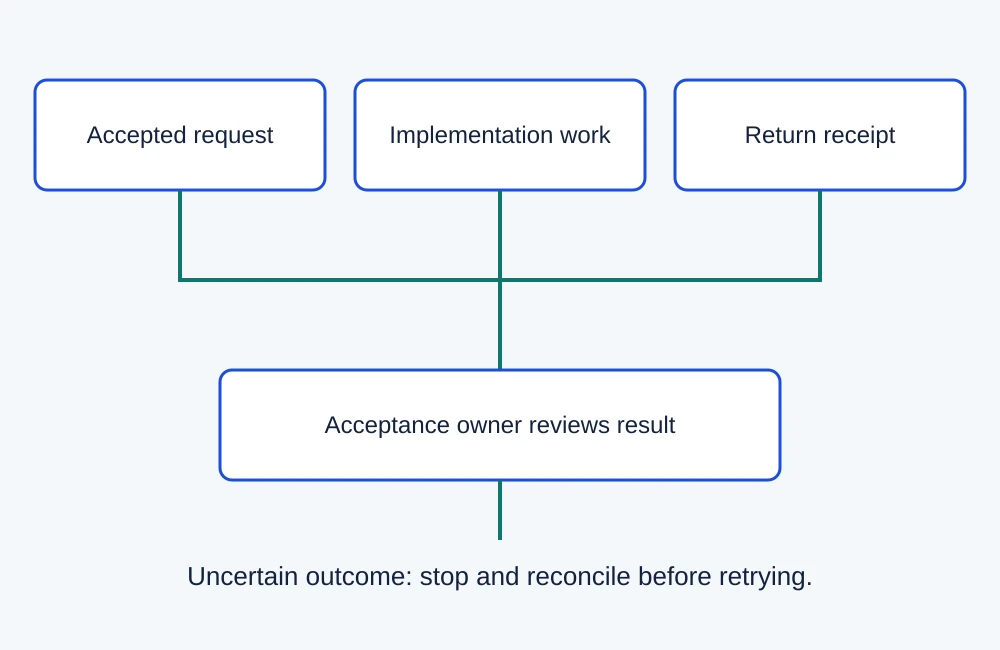
The risk is two independent promises. A date changed in one system may be missed in the other; a completed implementation may be mistaken for an accepted request. Decide which record owns each field. If a field must appear twice, specify who updates it and how disagreements are resolved.
Do not start by automating every update. First prove the manual handoff with fictional records. Try a corrected request and an uncertain result as well as the happy path. An absent response is not proof that a write failed, so reconcile before replaying a creation. Use the workflow automation examples to choose a bounded first automation only after the ownership rule is clear.
Compare the cost of the configuration you need
The pricing pages checked on 16 November 2026 list a Trello Free plan and include Issues and Projects in GitHub Free. That does not make the two configurations interchangeable or establish that every required control is included. Evaluate the relevant plan, roles and additional services before deciding that a free configuration passes.
A useful comparison separates subscription, migration, training and recurring administration. If the team already pays for GitHub, compare the incremental cost of the proposed change rather than charging its whole platform bill to project management again. If Trello would require another integration service or a second reporting routine, include that dependency.
For a fictional illustration, two hours of monthly reconciliation at an assumed £40 per hour represent £80 of economic cost, or £960 over twelve unchanged months. This is an input to challenge, not a measured result or an extra payroll bill. A £0 subscription can still be the costlier operating arrangement when records repeatedly disagree.
Use the ownership-cost calculator with the same currency, period and exclusions for both options. Do not count an assumed productivity gain as cash saved unless the team can explain how that capacity will actually be used. The Trello review and GitHub Projects review cover their individual buying considerations.
A successful download is not a complete exit
GitHub documents downloading a project view as TSV. Trello documents board JSON export and additional Premium export options. These are different routes with different scopes; neither filename alone proves the required history and relationships survive.
Choose a representative record with an accepted scope, ownership, discussion and implementation reference. Export through the route the team would actually retain. Compare the result with a written inventory of required information. Record what still depends on access to the original service.
Ask another authorised person to reconstruct the decision from the retained evidence. If they cannot determine what was accepted, the export has not met that requirement even if the file opens correctly. Use the software migration checklist to agree acceptance and rollback conditions before removing the old source.
Run the same bounded pilot in both candidates
- Agree one valid request, one incomplete request and one material amendment, all using fictional records.
- Assign the request owner, delivery owner and acceptance owner before choosing views.
- Ask the intended stakeholder to locate the current decision with their ordinary access.
- Complete a handoff and an uncertain result; check who reconciles the receipt.
- Export and reconcile the required evidence, then record pass, fail or unknown for each essential.
Use the pilot plan to record the actual tester, date, configuration and result. These proposed checks do not imply a fresh account test or benchmark for this article. Unknown essentials remain unresolved rather than becoming a passing score.
My recommendation
Choose Trello when a shared board can remain the maintained record for the whole delivery team. Choose GitHub Projects when repository-linked work already carries the useful detail and the intended participants can work with that arrangement. Use both only when their records serve distinct decisions and a named owner maintains the handoff.
If the main problem is unclear ownership, repair that first. Then use the broader shortlist to compare another approach if neither candidate meets the essential access, exit and operating requirements.
Explore the relevant product
Sources and image sources
Identities supplied through Atlassian and GitHub brand resources.