 Stuart Kerr Spindlow
Lightwell was a visual tool for creating interactive, animated mobile experiences. Its team joined Twitter in August 2019 and announced that active support and new feature development would end. For a new project, choose a maintained tool suited to what you want to build: an interactive story, an animated interface or a full application.
Independent historical guide: AppTrajectory is not Lightwell, Hullabalu or their support service. This page explains the former app builder associated with lightwell.pro. It does not provide account access, downloads or project recovery.

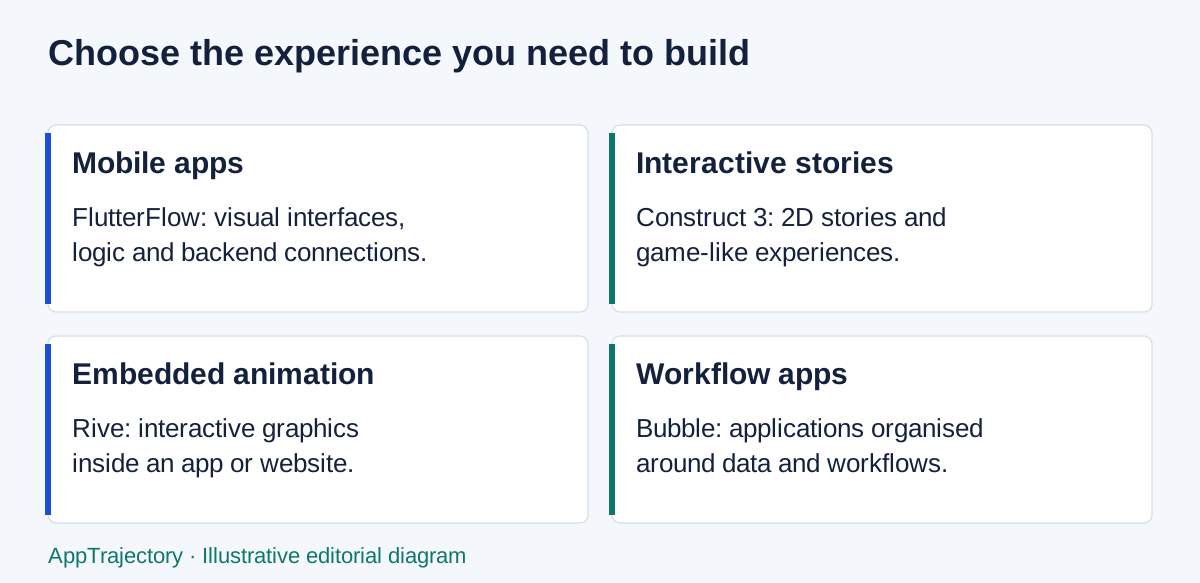
Read the diagram as text
- Mobile apps: FlutterFlow: visual interfaces, logic and backend connections.
- Interactive stories: Construct 3: 2D stories and game-like experiences.
- Embedded animation: Rive: interactive graphics inside an app or website.
- Workflow apps: Bubble: applications organised around data and workflows.
What was Lightwell?
Lightwell grew out of Hullabalu's work on interactive story apps. In its 2017 introduction, founder Suzanne Xie described a tool that let creators turn artwork into interactive native iOS apps without writing code.
The starting point was visual material and interaction: scenes, layers, animation and responses to the reader's actions. That made it particularly relevant to artists, designers and storytellers. Think of an illustrated scene in which tapping a character triggers an action, rather than a conventional business app centred on customer records and forms.
The distinction matters when choosing an alternative. A product that calls itself an app builder may focus on databases, interface design, games or animation. These solve different parts of the problem.
What happened to Lightwell?
On 20 August 2019, the Lightwell team announced it was joining Twitter. The announcement said Lightwell would become free to use without an account or subscription, while active support and new features would cease.
That was an end to active development, not an announcement that every published Lightwell app would immediately stop working. The team's assurances about existing apps described the situation in 2019. They do not establish compatibility with today's devices, development tools or app-store submission requirements.
For a new production project, I would treat Lightwell as historical software. If you already have a project, preserve its files before investigating whether it can still be opened or rebuilt.
Lightwell in education and digital storytelling
Lightwell also appeared in education. The team's Avenues classroom account described students using it for digital storytelling. This helps explain why old school-resource pages still point to the product.
If you arrived through one of those links, choose a replacement around the lesson rather than the old brand. Is the goal to sequence a story, practise interaction design, learn programming concepts or publish an application? A browser-based classroom exercise and a maintained mobile app have different requirements.
Before choosing a classroom tool, check device access, teacher administration, accessibility, student-account arrangements and how pupils can keep their work. Test the actual school setup before committing a class to it.
Modern alternatives: choose by the job
There is no single direct replacement for every Lightwell workflow. The following options are a shortlist based on current vendor descriptions, not results from hands-on comparative testing. None is presented as an automatic importer for Lightwell projects.
| What you want to create | Tool to investigate | Why it belongs on the shortlist | What to establish in a pilot |
|---|---|---|---|
| A visually built mobile application | FlutterFlow | Visual interface and logic tools, backend integrations and mobile/web deployment options | Required plan, device behaviour, backend costs and whether exported code can be maintained by your team |
| A 2D interactive story or game-like experience | Construct 3 | A 2D game-building environment with education resources and publishing documentation | Whether its interaction model fits the story, accessibility needs and intended publishing route |
| Interactive animation within an existing app or website | Rive | An interactive graphics and animation toolset | Who will integrate the result and how the chosen runtime behaves in the host application |
| A workflow or data-driven application | Bubble | A visual application platform with web and mobile offerings | Data permissions, operating costs, deployment requirements and the practicality of an eventual exit |
These are different categories, so a universal winner would be misleading. For an illustrated story, start by testing Construct. For a mobile application with data and business logic, investigate FlutterFlow. For animation inside a product your team already develops, investigate Rive. Consider Bubble when the main requirement is an application workflow rather than scene-based storytelling.
Those starting points are editorial judgements, not performance rankings. Verify current plans and publishing conditions before buying; no subscription prices are quoted here because cost depends on the required capabilities and operating setup.
How to choose a replacement without repeating the same problem
Start with the outcome and write down the essential requirements. Use the software requirements checklist to distinguish a must-have from a preference.
For a storytelling project, a representative test could be one scene with artwork, a user interaction, sound and a transition. For a business app, test a complete workflow with realistic permissions and sample data. These are suggested pilot tasks, not tests performed for this article.
Give each candidate the same brief. Record:
- Creation: Can your team build the representative experience without unexplained workarounds?
- Delivery: Can it reach the intended device or browser through a supported publishing route?
- Maintenance: Who will fix bugs, update dependencies and handle platform changes?
- Exit: Which assets, data and code can you export, and can someone actually reuse them?
- Cost: What will the required plan, hosting, integrations and maintenance time cost together?
Use the software evaluation scorecard to compare your own evidence. Leave unknowns visible. An export button is not proof that another developer can operate the application independently.
For a broader selection process, follow how to evaluate SaaS for a small team. Include transition and ongoing work using the total cost of ownership guide.
Existing projects, downloads and old tutorials
This page does not host a verified Lightwell installer or recreate its former resource library. We have not verified that an old download is compatible with a current operating system or that an existing project can be published today.
If you still have project files:
- Preserve an untouched copy of the project, artwork, audio, exported code and any build notes.
- Record the versions and dependencies used by the original working environment.
- Ask a developer to assess a copy before upgrading tools or changing the only working setup.
- Separate reusable creative assets from implementation that may need to be rebuilt.
- Test one representative scene in a maintained tool before estimating a full migration.
Old tutorials can explain the former product, but they are not current support instructions. A modern alternative may require a manual rebuild even when it can reuse your original images and sound.
Looking for the old Lightwell download or an account?
AppTrajectory cannot supply former accounts, subscriptions, installers or technical support. The original team's 2019 announcement described account-free use at that time; it is not a guarantee that an official download remains available now.
Can a modern builder open a Lightwell project?
This guide has not established a supported direct-import path for the shortlisted products. Plan around preserving the original assets, checking any available exports and rebuilding a small example before assuming migration is straightforward.
Sources and method
This is a source-based historical guide, not a hands-on test. Historical statements were checked against the original team's 2017 introduction, 2019 team announcement and education account. Alternative categories were checked against the official FlutterFlow, Construct, Rive and Bubble websites on 23 September 2026. Product suitability remains subject to your own pilot.