 Stuart Kerr Spindlow
Use AI to organise source notes, draft criteria from confirmed requirements and identify questions or dependencies for human review. Keep the source visible and require unknowns to remain unknown. People must confirm the requirements, estimates, permissions and final decisions; a fluent draft is not evidence that a stakeholder asked for the feature.

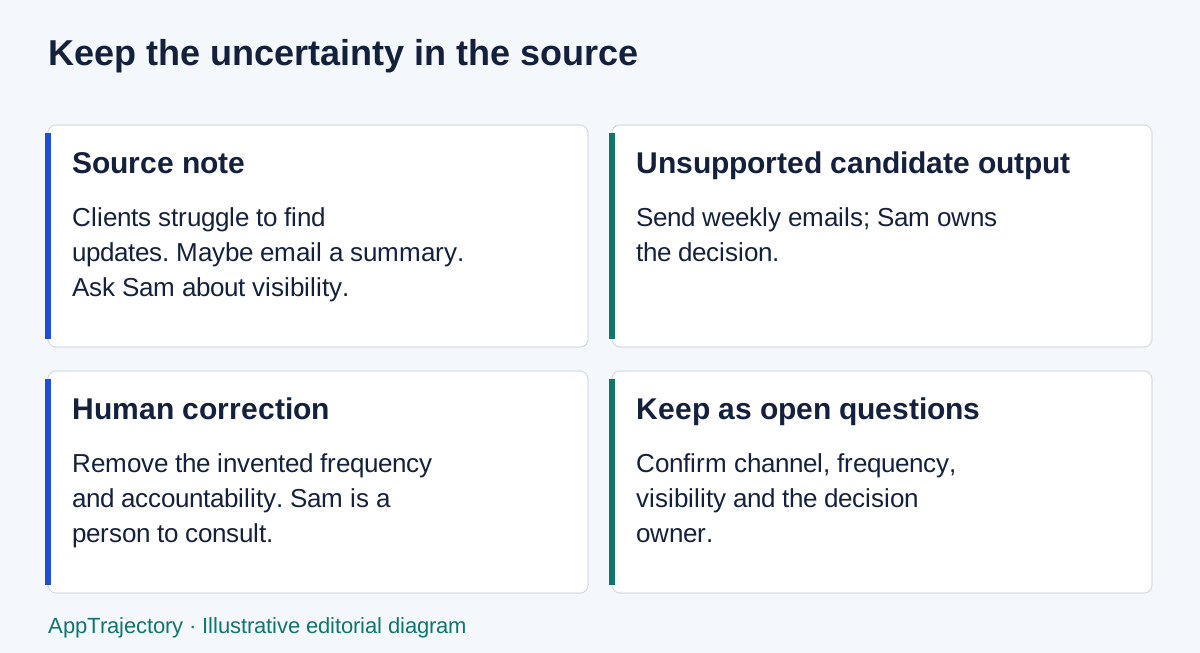
Read the diagram as text
- Source note: Clients struggle to find updates. Maybe email a summary. Ask Sam about visibility.
- Unsupported candidate output: Send weekly emails; Sam owns the decision.
- Human correction: Remove the invented frequency and accountability. Sam is a person to consult.
- Keep as open questions: Confirm channel, frequency, visibility and the decision owner.
Choose a bounded task with a checkable output
A helpful planning task has a defined input and an output a person can inspect. Examples include separating decisions from open questions, turning an approved requirement into candidate acceptance criteria or checking whether a roadmap depends on unresolved access work. These tasks help structure thinking without delegating accountability.
Avoid asking a model to invent “everything the product needs” and then treating the list as research. Plausible suggestions can be useful in a discussion, but they must remain proposals until the responsible people validate them. Do not assign a person, budget or delivery date because the draft makes the plan look more complete.
A small amount of source material may be easier to organise directly in a document. Use AI when the transformation saves useful effort and the review burden remains manageable. Adding an AI service is not automatically a better response to unclear notes.
Keep source, inference and decision separate
Before using a service, establish an approved basis for the data you will provide. Remove unnecessary personal, client and confidential information. Follow the organisation’s rules and the service’s applicable terms; do not assume a consumer interface has the same data handling as an approved work arrangement.
In the output, distinguish a confirmed requirement, an assumption, an estimate, a vendor claim and an observed result. The source may itself contain uncertainty. If someone says “perhaps clients need weekly updates”, the word perhaps matters. Converting that sentence into a committed notification feature changes the meaning.
Do not ask the model to manufacture citations. A source reference should point to an actual input or independently checked primary documentation. If the source cannot be verified, mark the claim unverified and keep it out of the confirmed requirements.
Prompt 1: extract decisions and open questions
Use only the notes below. Separate:
1. Explicitly accepted decisions, with the exact supporting note reference.
2. Proposed requirements that still need confirmation.
3. Open questions and conflicting statements.
4. Named owners only where the notes actually name them.
Preserve uncertainty. Write “unknown” for missing owners, dates or evidence.
Do not infer agreement from silence or invent a requirement.
Return a short table and list the questions a human must resolve.
Notes: [insert approved, appropriately redacted notes]
Illustrative incomplete note: “Clients struggle to find updates. Maybe email a summary. Ask Sam about visibility.” The appropriate output is: problem reported, update channel unconfirmed, frequency unknown, visibility unresolved and decision owner unknown. Sam is a person to consult; the note does not establish that Sam owns the final decision.
A poor output would schedule weekly emails and mark Sam accountable. It would add both a frequency and a responsibility absent from the source. The reviewer should remove those inventions, then ask the actual stakeholders to decide.
Prompt 2: draft criteria from confirmed requirements
Draft candidate acceptance criteria for the confirmed requirement below.
Keep the original requirement ID and outcome visible.
Include the ordinary path, permissions, invalid input, failure handling,
and keyboard/accessibility checks where relevant.
Separate criteria directly supported by the requirement from proposed checks.
Do not invent thresholds, data retention, roles or vendor features.
List missing decisions as questions; do not silently resolve them.
Label the entire output “draft for human review”.
Confirmed requirement: [insert approved requirement]
For a requirement to export approved request records, the model can propose checking delimiters, encoding and relationship identifiers. It should not claim attachments are included or prescribe a retention period without evidence. A person must decide which proposed checks are necessary and what an acceptable result means.
Compare every criterion back to the requirements worksheet. If a criterion introduces new functionality, treat it as a proposed scope change. Use the user-story examples to inspect whether the final wording is observable and appropriately bounded.
Prompt 3: critique dependencies
Review this roadmap and backlog for possible dependencies and contradictions.
Use only the supplied records. Reference the relevant item IDs.
Separate explicit dependencies from hypotheses that need investigation.
Flag outcomes with no supporting work and work with no stated outcome.
Do not estimate dates or effort unless supplied; preserve provided uncertainty.
Do not reorder mandatory constraints without identifying the responsible owner.
Return questions and review suggestions, not an approved delivery plan.
Records: [insert approved roadmap and backlog]
If reminders depend on request ownership, the draft can flag that relationship for investigation. It should not assert that a particular integration is supported or assign a launch date. An apparently missing dependency may already be handled in another system; the team must check before changing the plan.
A human decision checklist
- Does every confirmed statement have support in the source or verified evidence?
- Are suggestions, assumptions and estimates labelled separately?
- Have missing owners, dates and thresholds remained unknown?
- Do proposed criteria introduce unapproved scope?
- Have access, data and failure cases been considered without inventing policy?
- Can the responsible people explain and accept the final decision?
- Is sensitive information kept in the approved environment?
- Does the record say what was accepted and what still needs review?
Save the adopted decision and its supporting evidence in the team’s normal planning system. The model conversation can be background material, but it should not be the only place the team can find a commitment. Record substantive changes through the async decision log.
These prompts describe an editorial workflow, not a claim about any current model’s capabilities or reliability. Review effort should scale with consequence. An AI-assisted draft is useful only when it helps people make a better-supported decision and leaves uncertainty visible.
When AI earns its place in this workflow
I would use AI to produce a first structure from a substantial set of approved notes, then check every proposed decision against its source. For a short note such as the example about client updates, direct editing is the better default: the reviewer can see the unresolved channel and ownership immediately, without another draft to verify. This is editorial analysis of the task, not a measured comparison of models.
Compare total human effort, not just generation time. The relevant calculation is preparation + checking + correction + final recording, compared with doing the same task directly. If the AI route takes less drafting time but adds more checking time, the apparent saving can disappear. No timed records have been supplied for these prompts, so this guide makes no numerical productivity claim.
For quality, count unsupported commitments separately from harmless wording edits. In the incomplete-note example, scheduling a weekly email invents a frequency and naming Sam accountable invents an owner. Those are two distinct unsupported decisions in a deliberately constructed example, not an observed model error rate. My recommendation is to keep source references beside adopted decisions and use AI only while that review remains practical.