 Stuart Kerr Spindlow
A roadmap explains direction: which outcomes matter, why they matter and what the team intends to learn or improve. A backlog holds the more detailed work that could advance those outcomes. Connect the two with clear references, but do not treat every roadmap idea as a delivery promise or every backlog entry as a commitment.

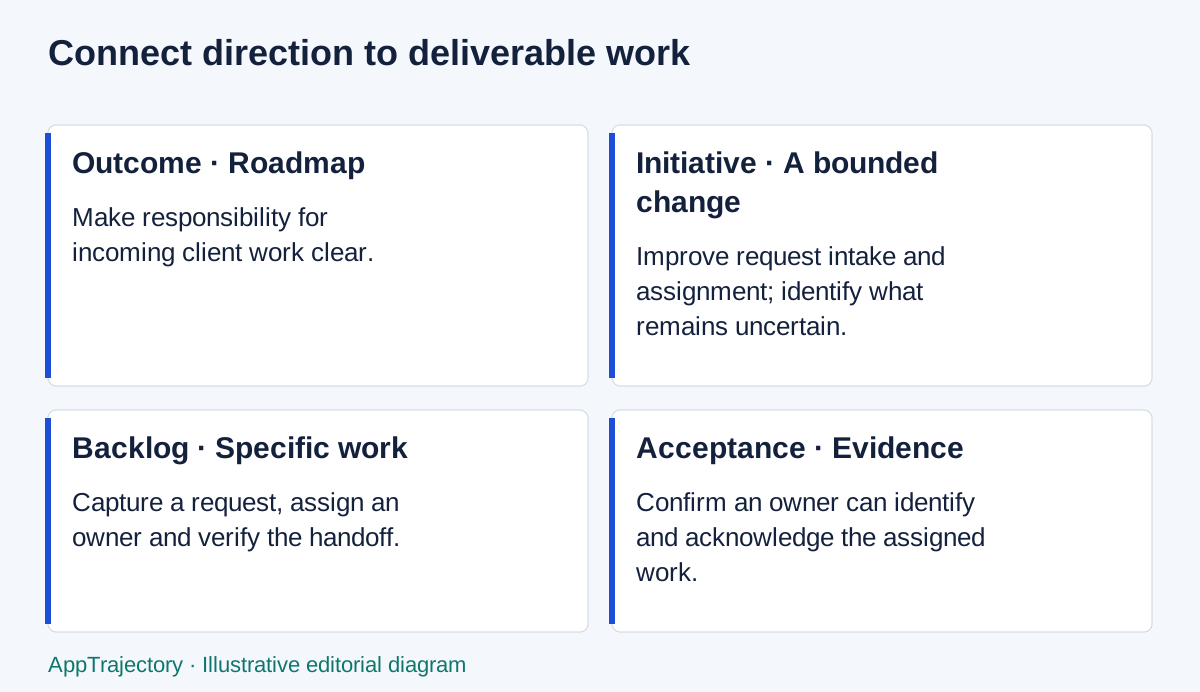
Read the diagram as text
- Outcome · Roadmap: Make responsibility for incoming client work clear.
- Initiative · A bounded change: Improve request intake and assignment; identify what remains uncertain.
- Backlog · Specific work: Capture a request, assign an owner and verify the handoff.
- Acceptance · Evidence: Confirm an owner can identify and acknowledge the assigned work.
Two views of the same work
| Dimension | Roadmap | Backlog |
|---|---|---|
| Purpose | Explain outcomes, direction and priorities | Make candidate delivery work understandable and orderable |
| Audience | Team, decision owners and stakeholders | People preparing, implementing and accepting work |
| Horizon | Nearer and more distant intentions, with confidence shown | Detailed near-term work plus less developed candidates |
| Detail | Problem, outcome, initiative and evidence | Tasks or stories, acceptance conditions and dependencies |
| Ownership | A named person accountable for product direction | A named person accountable for ordering and clarification |
| Update cadence | When evidence or priorities change; review at an agreed rhythm | As items are refined, completed, removed or reordered |
| Meaning of a date | A target or commitment only when explicitly agreed | A scheduled item only when capacity and dependencies are considered |
This comparison describes general product practice. Scrum defines a Product Goal and Product Backlog, with the Product Owner accountable for effective backlog management. It does not require this particular roadmap format. Use the Scrum Guide for Scrum’s actual terms rather than treating a convenient planning template as a framework rule.
Begin with an outcome people recognise
Illustrative situation: a small agency wants new client work to begin with the necessary information already collected. “Launch an onboarding portal” names a solution. “Make readiness visible before work starts” names an outcome that might be achieved with a checklist, a shared form or a configured platform.
The initial evidence might be interview notes suggesting missing information at handoff. Until someone examines real cases, mark that as an assumption supported by limited evidence. A proposed reduction in incomplete handoffs is a target, not a measured result. Choose a baseline method and an owner before attaching a numerical promise to the roadmap.
A useful roadmap entry can therefore contain the outcome, the affected group, the evidence to gather, the decision owner and a confidence label. The initiative remains provisional until a small test establishes which part of the process needs to change.
From outcome to an accepted item
| Layer | Example | Decision or evidence |
|---|---|---|
| Outcome | Make client readiness visible before delivery begins | Agree what ready means and observe current handoffs |
| Initiative | Create one shared readiness checklist | Test the checklist on representative sample projects |
| Backlog item | Show an owner and missing prerequisite for each onboarding request | Confirm roles, data and status rules |
| Acceptance check | A coordinator identifies missing inputs; a client sees only their own request | Record successful and prohibited actions with test accounts |
| Review | Assess whether the checklist solves the handoff problem | Continue, change approach or stop based on evidence |
Suppose the pilot reveals that unclear responsibility causes the delay, while the existing spreadsheet already displays every required field. The roadmap outcome remains useful. The portal initiative can be dropped and the backlog can contain a smaller ownership change. Preserving a feature simply because it appeared on a slide would make the artefact more important than the problem.
Link the backlog item to its originating initiative and requirement. Record the acceptance owner beside the item. This is enough traceability for many small teams; avoid elaborate identifiers that take more work to maintain than the decisions they explain.
Make dates mean something
Use “now, next, later” if it helps communicate relative attention, but explain what each label means. “Next” might mean the team intends to investigate after current work, not that implementation begins next Monday. Calendar dates can be appropriate for a real event or contractual obligation; label the commitment and its source.
Separate a fixed constraint from an estimate. If a client launch is fixed, the scope may need to shrink. If scope is fixed, the delivery estimate may need a range. A roadmap showing fixed dates, fixed scope and untested dependencies creates false confidence. Discuss which variable can change before presenting the plan.
Do not quietly move an overdue commitment into a later column. Keep a short decision record stating what changed, why and who was informed. An honest revision is more useful than a visually tidy but misleading roadmap.
Keep both views maintainable
- At roadmap review, ask whether the outcome still matters and whether the evidence supports the initiative.
- Before selecting delivery work, make the acceptance conditions and prerequisites explicit.
- Remove stale backlog items that have no current owner or plausible connection to an outcome.
- Keep exploratory ideas separate from ready work without implying every idea will be built.
- After a release or process change, inspect the outcome as well as the count of completed items.
Do not use the backlog as an unfiltered archive of every conversation. Preserve valuable background in a decision record, then link only the actionable work. Equally, do not fill the roadmap with dozens of implementation tasks; readers should be able to understand the direction without decoding tickets.
Choose the smallest planning system that works
For two people, a document for direction and a short spreadsheet for delivery may be enough. Buy a planning tool when a confirmed need, such as access separation or cross-team dependencies, justifies its administration cost. More views do not automatically create a shared understanding.
Use backlog prioritisation to explain the next trade-off and async decision records to communicate changes. The useful test is whether someone can trace today’s work back to an agreed outcome and explain what evidence would change the plan.
Which view should lead the discussion?
For a stakeholder deciding whether onboarding is the next priority, I would lead with the roadmap outcome and its evidence. For the coordinator choosing what to prepare today, I would lead with the ordered backlog and its acceptance conditions. Combining both audiences into one long task list makes direction harder to see; maintaining two unrelated plans makes delivery harder to explain.
The practical compromise is one outcome reference on each selected backlog item. In the worked chain, the outcome, initiative, item, acceptance check and review form five linked layers. That is traceability, not five separate documents to maintain. Count selected items with no outcome reference and outcomes with no supporting work as review prompts; neither count is a measure of customer value.
I prefer now/next/later for uncertain discovery and explicit dates for a real commitment. Date-based roadmaps win when a launch or obligation genuinely fixes the timing; otherwise they can make an untested estimate look agreed.