 Stuart Kerr Spindlow
Choose between buying SaaS, configuring a platform and custom development by comparing the required workflow, differentiation, available capacity and lifecycle cost. Begin with the possibility of improving the existing process. There is no universal winner: the right approach is the smallest one that meets the essentials and can be maintained by a named team.

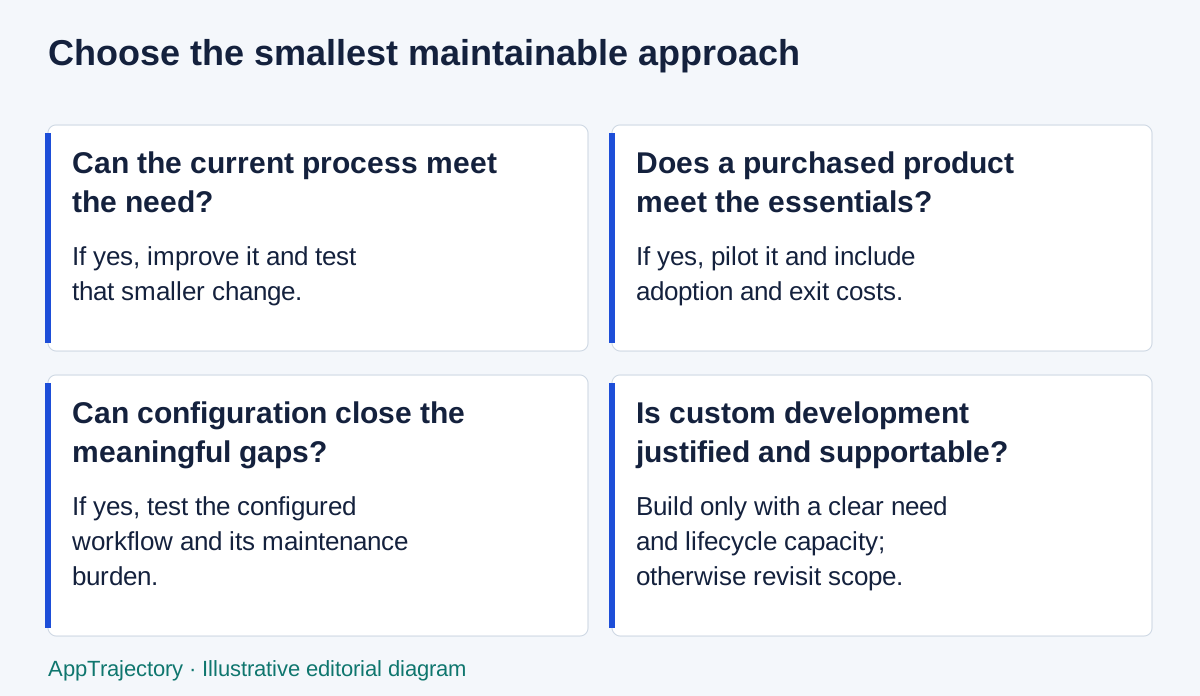
Read the diagram as text
- Can the current process meet the need?: If yes, improve it and test that smaller change.
- Does a purchased product meet the essentials?: If yes, pilot it and include adoption and exit costs.
- Can configuration close the meaningful gaps?: If yes, test the configured workflow and its maintenance burden.
- Is custom development justified and supportable?: Build only with a clear need and lifecycle capacity; otherwise revisit scope.
Decide what must be different
Describe the outcome without naming a technology. An agency may need consistent approval of client work. A SaaS product could provide the workflow; a configured platform could assemble it; custom software could implement unusual rules. A shared checklist might be enough if the main problem is unclear responsibility.
Ask whether the unusual part creates meaningful value or simply reflects a habit. A workflow that is different from a vendor’s default does not automatically justify custom development. Conversely, forcing a genuinely distinctive operation into a rigid product may create expensive workarounds. Record the evidence for the difference before making it an architectural commitment.
List non-negotiable constraints for data, access, accessibility, integrations and exit. Give each a responsible reviewer. Any approach that cannot plausibly satisfy those constraints needs further investigation or removal from consideration, regardless of its apparent speed.
Compare the approaches
| Dimension | Buy SaaS | Configure or use no-code | Custom development |
|---|---|---|---|
| Workflow fit | Strong when standard behaviour matches the job | Adaptable within platform rules | Can target unusual needs, subject to scope and delivery quality |
| Time to usable result | Setup may be quick; adoption and migration still take work | Configuration and validation can be substantial | Discovery, implementation and ongoing releases need capacity |
| Differentiation | Usually limited by vendor roadmap | Possible within supported logic and data model | Potentially high, if the difference is valuable |
| Maintenance | Vendor runs product; team owns configuration and use | Team owns rules, dependencies and platform changes | Team owns application maintenance, operations and security work |
| Integration | Confirm exact plan and supported data movement | Check connectors, limits and failure handling | Interfaces can be built but still need stable external APIs |
| Access | Available roles must fit requirements | Permissions may constrain the architecture | Controls require design, implementation and verification |
| Portability | Test exports and contract terms | Assess data and application-logic exit separately | Ownership of source does not guarantee portable infrastructure |
| Cost | Subscription plus implementation and internal time | Platform fees plus configuration and maintenance | Development plus hosting, support and ongoing change |
The matrix describes trade-offs, not current product promises. Verify a named platform’s actual plan and terms before relying on them. No-code does not mean no technical responsibility: someone must understand the data model, manage changes and respond when a workflow fails.
An illustrative approval-workflow decision
Consider an eight-person agency that collects client feedback and confirms acceptance. The team assumes it needs a bespoke portal because email threads are difficult to follow. Its confirmed requirement is narrower: preserve the approved version, identify the approver and prevent one client seeing another’s files.
First trial an agreed approval record in the existing workspace. If that meets the need, stop there. If the access model is inadequate, evaluate SaaS with the required client boundaries. A configured platform becomes relevant if the approval rules are unusual but expressible within its permissions and data model.
Custom development might become reasonable if complex approval rules are central to the business and no viable configuration meets them. Before choosing it, name who will own releases, backups, access recovery, dependency updates and support after the original developer finishes. A development quote that omits those responsibilities is incomplete.
The example does not prove which approach is cheapest. It shows a sequence that avoids committing to a large solution before establishing the actual constraint. The evidence that would change the decision should be written down: a failed access test, an essential integration gap or a confirmed differentiating rule.
Price the responsibility, not only the build
Compare costs over the same useful horizon. Include setup, migration, training, ongoing administration, support, overlap and exit. Separate supplier cash costs from the value of internal time. For custom development, include the expected effort to change and operate the software after launch, with uncertainty ranges rather than a false fixed forecast.
Ask what happens if the person maintaining the system leaves. Can another colleague understand it from documentation and a handover? Are the accounts owned by the organisation? Can the team restore an export or backup? These questions apply to configured and purchased software as well as custom applications.
Use the ownership-cost guide to build a comparable estimate. The SaaS calculator deliberately does not model a full custom-development budget; do not force a complex project estimate into a per-seat subscription formula.
Distinguish a website from an application
A marketing website and an application with accounts and business logic have different needs. StuartKerrs.com's Webflow and Bubble comparison explores that narrower platform choice. Related publication from the same publisher.
For your decision, identify whether the essential outcome is publishing information or operating a shared process with persistent records and permissions. A visually impressive page builder is not evidence that a platform supports the required application logic. Equally, a powerful application platform may add unnecessary maintenance for a straightforward publication.
Write the decision before committing
Problem and confirmed requirements:
Approaches considered, including current process:
Essential gates and supporting evidence:
Preferred approach and reasons:
Expected cost range and exclusions:
Who operates and maintains it:
Exit route and unresolved dependencies:
Smallest pilot that could change the decision:
Approval owner and review trigger:
Start a pilot around the riskiest assumption, not the easiest demonstration. If all approaches remain uncertain, return to the requirements worksheet and narrow the problem. Buying later after a useful investigation can be a better decision than selecting a platform to create a feeling of progress.
My recommendation for a small team
For the eight-person approval example, my first choice is to improve the existing approval record. If it cannot enforce the client boundary, buying a suitable SaaS product is the next choice. Configure a platform when the differentiating rule is clear and someone can maintain it. Commission custom software only when that rule has enough value to justify owning releases, support and recovery. This ordering follows the example’s constraints, not a claim that buying is always cheaper.
The cost comparison should use the same horizon. For a three-year decision, annual recurring cost contributes three times its yearly amount, while a genuine one-off implementation cost is counted once. For example, an additional £1,000 of recurring annual cost adds £3,000 over that horizon before discounting or price changes. This is sensitivity arithmetic, not a supplier estimate. There is no verified development quote or operating record here from which to claim a cash winner.
The decisive tradeoff is flexibility versus continuing responsibility. A bespoke approval path is worth considering when it serves a confirmed business need; reproducing a familiar screen is too weak a reason to acquire a software-maintenance obligation.
When to choose a different approach
Buy or configure when the essential workflow can be met with acceptable control and operating cost. Build when a genuinely differentiating requirement rules out available approaches and the team can own delivery, maintenance, security and exit. Improve the current process when the problem is unclear ownership rather than missing capability.
Before committing, prototype the requirement most likely to disqualify the approach. Keep optional customisations outside the gate list, compare the same ownership horizon and name who sustains the result. An attractive initial build quote does not remove switching or support costs.